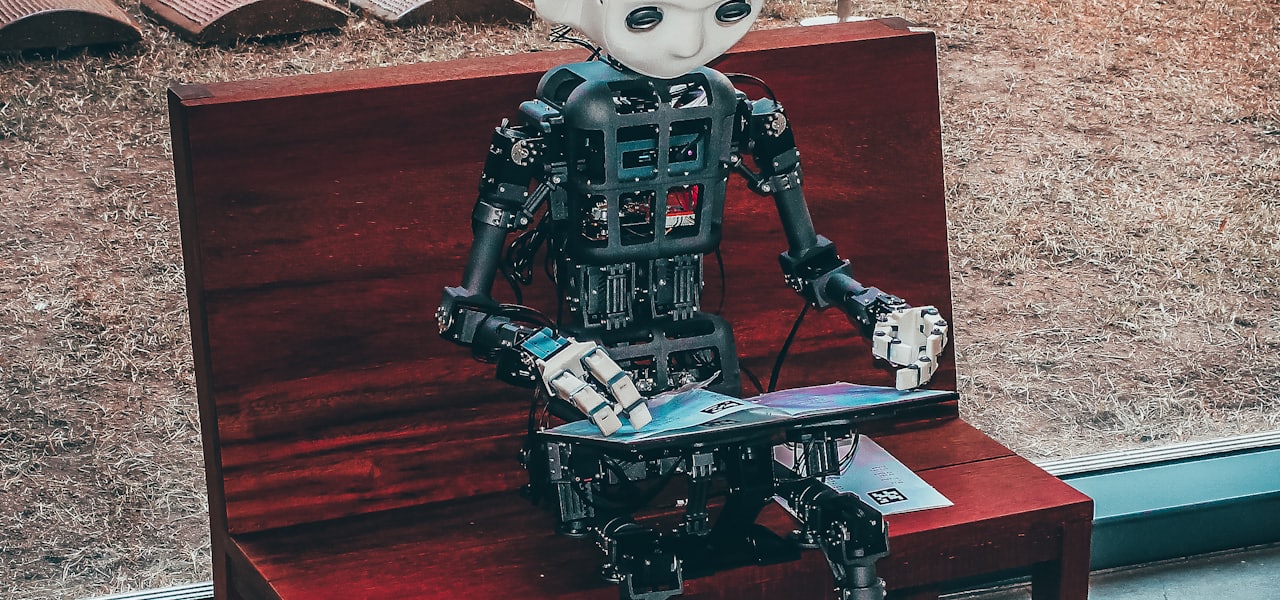
Agentive logic (also called the logic of action or logic of agency) is the field of philosophical logic and logic in computer science that studies formal representations of agents, their actions, and their abilities. An agentive logic in the narrower sense is a formal system whose primitive operators express that an agent does something, can do something, or sees to it that something is the case. Agentive logics generalise modal logic by adding modalities indexed to agents and to actions. Typical examples include: STIT logics (from sees to it that) with operators of the form [ i s t i t : φ ] {\displaystyle [i\ {\mathsf {stit}}:\varphi ]} meaning that agent i {\displaystyle i} sees to it that φ {\displaystyle \varphi } holds; dynamic logics of action with program-like modalities [ α ] φ {\displaystyle [\alpha ]\varphi } and ⟨ α ⟩ φ {\displaystyle \langle \alpha \rangle \varphi } meaning, roughly, that after every (respectively, some) execution(s) of action α {\displaystyle \alpha } , φ {\displaystyle \varphi } holds; logics with explicit agentive operators such as "can do", "brings about", or "is able to ensure". Agentive logics are used in action theory in philosophy, in the semantics of natural language, in the theory of program verification, and in artificial intelligence, where they underpin formalisms for reasoning about actions, planning, and intelligent agents. == Terminology and scope == The adjective agentive derives from the Latin agens ("one who acts") and originally referred to the grammatical agent of a verb. In logical contexts it designates operators or predicates whose primary argument position is an agent rather than a proposition alone, for example A i φ {\displaystyle A_{i}\varphi } ("agent i {\displaystyle i} does φ {\displaystyle \varphi } ") or C i φ {\displaystyle C_{i}\varphi } ("agent i {\displaystyle i} can bring about φ {\displaystyle \varphi } "). In contemporary literature, agentive logic is sometimes used narrowly for formal reconstructions of St. Anselm's modal account of facere ("to do"). More broadly, the term is used interchangeably with logic of action or logic of agency to cover a family of modal and dynamic logics designed to capture the structure of action and choice. == Historical background == === Medieval and early modern roots === Medieval logicians already explored analogies between modalities of action and alethic modalities such as possibility and necessity, for instance, in discussions of obligation and power. An influential early agentive analysis is due to St. Anselm (11th century), who treated "doing φ {\displaystyle \varphi } " as a kind of modal operator on propositions, anticipating later modal logics of agency. Modern reconstructions of Anselm's theory show that the resulting "agentive logic" can be modelled with neighbourhood semantics and satisfies a recognisable square of opposition. === Modern logic of action === Modern study of the logic of action began in the mid-20th century, parallel to developments in deontic logic and tense logic. Early systems were proposed by Georg Henrik von Wright, Stig Kanger, and others, often motivated by questions about norms and responsibility. From the 1960s onward, two largely independent but eventually converging traditions emerged: a branching-time tradition, culminating in STIT logics, emphasising agents' choices among possible futures; and dynamic logics of programs and actions, developed within computer science to reason about program execution. In the 1990s and 2000s, action logics were further developed in connection with knowledge representation, planning, and multi-agent systems in AI, and with dynamic and update semantics in linguistics. == Core ideas == Despite their diversity, most agentive logics share some general themes: Agents are treated as explicit indices of modal operators, as in [ i d o e s ] φ {\displaystyle [i\ {\mathsf {does}}]\varphi } or C i φ {\displaystyle C_{i}\varphi } . Actions are represented either implicitly, via changes between possible worlds along an accessibility relation, or explicitly, as terms denoting primitive and composite actions. Choice and ability are captured by modalities describing what an agent can ensure, usually relative to assumptions about the environment and other agents. Formal properties such as closure under composition, interaction between different agents, and connections to obligation (what an agent ought to do) and knowledge (what an agent knows how to do) are investigated. == STIT logics == STIT ("sees to it that") logics, originating in work by Nuel Belnap and collaborators, treat agency in a branching-time framework. A STIT model consists of a partially ordered set of moments with a tree-like structure, sets of histories (maximal branches through the tree), and for each agent at each moment, a partition of the histories through that moment representing the choices available to the agent. Intuitively, an agent's action at a moment determines which equivalence class (choice cell) of histories becomes actual; a formula [ i s t i t : φ ] {\displaystyle [i\ {\mathsf {stit}}:\varphi ]} is true at a history–moment pair if φ {\displaystyle \varphi } holds on all histories in the choice cell corresponding to the agent's current action. Different STIT operators have been distinguished, notably: the Chellas STIT operator, often written [ i c s t i t : φ ] {\displaystyle [i\ {\mathsf {cstit}}:\varphi ]} , which requires only that the agent's choice guarantees φ {\displaystyle \varphi } ; and the deliberative STIT operator, [ i d s t i t : φ ] {\displaystyle [i\ {\mathsf {dstit}}:\varphi ]} , which additionally requires that φ {\displaystyle \varphi } is not already historically necessary. STIT frameworks have been extended with group agency operators, temporal modalities, epistemic operators, and deontic operators to study responsibility, collective action, and obligations under indeterminism. == Dynamic logics of action == Dynamic logic was originally developed to reason about the behaviour of computer programs, treating program execution as a kind of action. In propositional dynamic logic (PDL), action terms α , β , … {\displaystyle \alpha ,\beta ,\dots } denote abstract programs or actions, and formulas of the form [ α ] φ {\displaystyle [\alpha ]\varphi } and ⟨ α ⟩ φ {\displaystyle \langle \alpha \rangle \varphi } express that all, respectively some, terminating executions of α {\displaystyle \alpha } lead to states where φ {\displaystyle \varphi } holds. From the standpoint of agentive logic, dynamic logic provides: a language for building complex actions from primitives via sequencing, choice, and iteration (e.g., α ; β {\displaystyle \alpha ;\beta } , α ∪ β {\displaystyle \alpha \cup \beta } , α ∗ {\displaystyle \alpha ^{}} ); a Kripke semantics in which actions correspond to labelled accessibility relations; and proof systems (such as Hoare logic and weakest precondition calculi) for reasoning about the correctness of action sequences. Extensions such as concurrent dynamic logic add operators for parallel composition, allowing reasoning about interacting processes and concurrent actions. John-Jules Ch. Meyer and others have argued that dynamic logic is a natural base for logics of agents, by adding modalities for knowledge, belief, and ability on top of the action modalities. Dynamic logics have also been applied to normative reasoning, yielding dynamic deontic logics where actions are related to obligations and permissions, and to dynamic epistemic logics in which information-changing actions such as announcements are modelled as programs. == Situation calculus and other action formalisms == In artificial intelligence, reasoning about action and change is often based on first-order languages that explicitly represent situations, events, and fluents (time-varying properties). The best known is situation calculus, introduced by John McCarthy and developed extensively by Raymond Reiter. In such formalisms: action terms name primitive actions; a function symbol (often d o {\displaystyle {\mathsf {do}}} ) maps an action and a situation to a successor situation; and axioms describe which fluents hold in which situations and how actions change them. Reiter's successor state axioms give compact specifications of how each fluent changes under all actions, and precondition axioms specify when actions are possible. Related formalisms include the event calculus and fluent calculus, which provide alternative ways of representing events and their effects. While these systems are often first-order rather than modal, they are closely related to agentive logics: their action terms and transition structures can be seen as providing models for dynamic or STIT-style modalities, and conversely, dynamic logics can be used as abstract specification languages for such AI formalisms. == Ability, agency, and related modalities == Many agentive logics introduce explicit operators for ability or "can-do"
Control-flow integrity
Control-flow integrity (CFI) is a general term for computer security techniques that prevent a wide variety of malware attacks from redirecting the flow of execution (the control flow) of a program. == Background == A computer program commonly changes its control flow to make decisions and use different parts of the code. Such transfers may be direct, in that the target address is written in the code itself, or indirect, in that the target address itself is a variable in memory or a CPU register. In a typical function call, the program performs a direct call, but returns to the caller function using the stack – an indirect backward-edge transfer. When a function pointer is called, such as from a virtual table, we say there is an indirect forward-edge transfer. Attackers seek to inject code into a program to make use of its privileges or to extract data from its memory space. Before executable code was commonly made read-only, an attacker could arbitrarily change the code as it is run, targeting direct transfers or even do with no transfers at all. After W^X became widespread, an attacker wants to instead redirect execution to a separate, unprotected area containing the code to be run, making use of indirect transfers: one could overwrite the virtual table for a forward-edge attack or change the call stack for a backward-edge attack (return-oriented programming). CFI is designed to protect indirect transfers from going to unintended locations. == Techniques == Associated techniques include code-pointer separation (CPS), code-pointer integrity (CPI), stack canaries, shadow stacks (SS), and vtable pointer verification. These protections can be classified into either coarse-grained or fine-grained based on the number of targets restricted. A coarse-grained forward-edge CFI implementation, could, for example, restrict the set of indirect call targets to any function that may be indirectly called in the program, while a fine-grained one would restrict each indirect call site to functions that have the same type as the function to be called. Similarly, for a backward edge scheme protecting returns, a coarse-grained implementation would only allow the procedure to return to a function of the same type (of which there could be many, especially for common prototypes), while a fine-grained one would enforce precise return matching (so it can return only to the function that called it). == Implementations == Related implementations are available in Clang (LLVM front-end),, GNU Compiler Collection, Microsoft's Control Flow Guard and Return Flow Guard, Google's Indirect Function-Call Checks and Reuse Attack Protector (RAP). === LLVM/Clang === The LLVM compiler's C/C++ front-end Clang provides a number of "CFI" schemes that works on the forward edge by checking for errors in virtual tables and type casts. Not all of the schemes are supported on all platforms and most of them, the exception being two "kcfi" schemes intended for low-level kernel software, depends on link-time optimization (LTO) to know what functions are supposed to be called in normal cases. Also provided is a separate "shadow call stack" (SCS) instrumentation pass that defends on the backward edge by checking for call stack modifications, available only for the aarch64 and RISC-V ISAs. And due to use of a shared processor register SCS is only enforceable on certain ABIs or if in other ways it is ensured that any other software using the register set (thread/processor) does not interfere with this use. Google has shipped Android with the Linux kernel compiled by Clang with link-time optimization (LTO) and CFI enabled since 2018. Even though SCS is available for the Linux kernel as an option, and support is also available for Android's system components it is recommended only to enable it for components for which it can be ensured that no third party code is loaded. === GCC === The GNU Compiler Collection implemented a "shadow call stack" compatible with Clang for aarch64 in v12 released in 2022. This feature is primarily intended for building the Linux kernel as support is missing from GCC user space libraries. === Intel Control-flow Enforcement Technology === Intel Control-flow Enforcement Technology (CET) detects compromises to control flow integrity with a shadow stack (SS) and indirect branch tracking (IBT). The kernel must map a region of memory for the shadow stack not writable to user space programs except by special instructions. The shadow stack stores a copy of the return address of each CALL. On a RET, the processor checks if the return address stored in the normal stack and shadow stack are equal. If the addresses are not equal, the processor generates an INT #21 (Control Flow Protection Fault). Indirect branch tracking detects indirect JMP or CALL instructions to unauthorized targets. It is implemented by adding a new internal state machine in the processor. The behavior of indirect JMP and CALL instructions is changed so that they switch the state machine from IDLE to WAIT_FOR_ENDBRANCH. In the WAIT_FOR_ENDBRANCH state, the next instruction to be executed is required to be the new ENDBRANCH instruction (ENDBR32 in 32-bit mode or ENDBR64 in 64-bit mode), which changes the internal state machine from WAIT_FOR_ENDBRANCH back to IDLE. Thus every authorized target of an indirect JMP or CALL must begin with ENDBRANCH. If the processor is in a WAIT_FOR_ENDBRANCH state (meaning, the previous instruction was an indirect JMP or CALL), and the next instruction is not an ENDBRANCH instruction, the processor generates an INT #21 (Control Flow Protection Fault). On processors not supporting CET indirect branch tracking, ENDBRANCH instructions are interpreted as NOPs and have no effect. === Microsoft Control Flow Guard === Control Flow Guard (CFG) was first released for Windows 8.1 Update 3 (KB3000850) in November 2014. Developers can add CFG to their programs by adding the /guard:cf linker flag before program linking in Visual Studio 2015 or newer. As of Windows 10 Creators Update (Windows 10 version 1703), the Windows kernel is compiled with CFG. The Windows kernel uses Hyper-V to prevent malicious kernel code from overwriting the CFG bitmap. CFG operates by creating a per-process bitmap, where a set bit indicates that the address is a valid destination. Before performing each indirect function call, the application checks if the destination address is in the bitmap. If the destination address is not in the bitmap, the program terminates. This makes it more difficult for an attacker to exploit a use-after-free by replacing an object's contents and then using an indirect function call to execute a payload. ==== Implementation details ==== For all protected indirect function calls, the _guard_check_icall function is called, which performs the following steps: Convert the target address to an offset and bit number in the bitmap. The highest 3 bytes are the byte offset in the bitmap The bit offset is a 5-bit value. The first four bits are the 4th through 8th low-order bits of the address. The 5th bit of the bit offset is set to 0 if the destination address is aligned with 0x10 (last four bits are 0), and 1 if it is not. Examine the target's address value in the bitmap If the target address is in the bitmap, return without an error. If the target address is not in the bitmap, terminate the program. ==== Bypass techniques ==== There are several generic techniques for bypassing CFG: Set the destination to code located in a non-CFG module loaded in the same process. Find an indirect call that was not protected by CFG (either CALL or JMP). Use a function call with a different number of arguments than the call is designed for, causing a stack misalignment, and code execution after the function returns (patched in Windows 10). Use a function call with the same number of arguments, but one of pointers passed is treated as an object and writes to a pointer-based offset, allowing overwriting a return address. Overwrite the function call used by the CFG to validate the address (patched in March 2015) Set the CFG bitmap to all 1's, allowing all indirect function calls Use a controlled-write primitive to overwrite an address on the stack (since the stack is not protected by CFG) === Microsoft eXtended Flow Guard === eXtended Flow Guard (XFG) has not been officially released yet, but is available in the Windows Insider preview and was publicly presented at Bluehat Shanghai in 2019. XFG extends CFG by validating function call signatures to ensure that indirect function calls are only to the subset of functions with the same signature. Function call signature validation is implemented by adding instructions to store the target function's hash in register r10 immediately prior to the indirect call and storing the calculated function hash in the memory immediately preceding the target address's code. When the indirect call is made, the XFG validation function compares the value in r10 to the target
Knowledge graph embedding
In representation learning, knowledge graph embedding (KGE), also called knowledge representation learning (KRL), or multi-relation learning, is a machine learning task of learning a low-dimensional representation of a knowledge graph's entities and relations while preserving their semantic meaning. Leveraging their embedded representation, knowledge graphs can be used for various applications such as link prediction, triple classification, entity recognition, clustering, and relation extraction. == Definition == A knowledge graph G = { E , R , F } {\displaystyle {\mathcal {G}}=\{E,R,F\}} is a collection of entities E {\displaystyle E} , relations R {\displaystyle R} , and facts F {\displaystyle F} . A fact is a triple ( h , r , t ) ∈ F {\displaystyle (h,r,t)\in F} that denotes a link r ∈ R {\displaystyle r\in R} between the head h ∈ E {\displaystyle h\in E} and the tail t ∈ E {\displaystyle t\in E} of the triple. Another notation that is often used in the literature to represent a triple (or fact) is ⟨ head , relation , tail ⟩ {\displaystyle \langle {\text{head}},{\text{relation}},{\text{tail}}\rangle } . This notation is called the Resource Description Framework (RDF). A knowledge graph represents the knowledge related to a specific domain; leveraging this structured representation, it is possible to infer a piece of new knowledge from it after some refinement steps. However, nowadays, people have to deal with the sparsity of data and the computational inefficiency to use them in a real-world application. The embedding of a knowledge graph is a function that translates each entity and each relation into a vector of a given dimension d {\displaystyle d} , called embedding dimension. It is even possible to embed the entities and relations with different dimensions. The embedding vectors can then be used for other tasks. A knowledge graph embedding is characterized by four aspects: Representation space: The low-dimensional space in which the entities and relations are represented. Scoring function: A measure of the goodness of a triple-embedded representation. Encoding models: The modality in which the embedded representation of the entities and relations interact with each other. Additional information: Any additional information coming from the knowledge graph that can enrich the embedded representation. Usually, an ad hoc scoring function is integrated into the general scoring function for each additional piece of information. == Embedding procedure == All algorithms for creating a knowledge graph embedding follow the same approach. First, the embedding vectors are initialized to random values. Then, they are iteratively optimized using a training set of triples. In each iteration, a batch of size b {\displaystyle b} triples is sampled from the training set, and a triple from it is sampled and corrupted—i.e., a triple that does not represent a true fact in the knowledge graph. The corruption of a triple involves substituting the head or the tail (or both) of the triple with another entity that makes the fact false. The original triple and the corrupted triple are added in the training batch, and then the embeddings are updated, optimizing a scoring function. Iteration stops when a stop condition is reached. Usually, the stop condition depends on the overfitting of the training set. At the end, the learned embeddings should have extracted semantic meaning from the training triples and should correctly predict unseen true facts in the knowledge graph. === Pseudocode === The following is the pseudocode for the general embedding procedure. algorithm Compute entity and relation embeddings input: The training set S = { ( h , r , t ) } {\displaystyle S=\{(h,r,t)\}} , entity set E {\displaystyle E} , relation set R {\displaystyle R} , embedding dimension k {\displaystyle k} output: Entity and relation embeddings initialization: the entities e {\displaystyle e} and relations r {\displaystyle r} embeddings (vectors) are randomly initialized while stop condition do S b a t c h ← s a m p l e ( S , b ) {\displaystyle S_{batch}\leftarrow sample(S,b)} // Sample a batch from the training set for each ( h , r , t ) {\displaystyle (h,r,t)} in S b a t c h {\displaystyle S_{batch}} do ( h ′ , r , t ′ ) ← s a m p l e ( S ′ ) {\displaystyle (h',r,t')\leftarrow sample(S')} // Sample a corrupted fact T b a t c h ← T b a t c h ∪ { ( ( h , r , t ) , ( h ′ , r , t ′ ) ) } {\displaystyle T_{batch}\leftarrow T_{batch}\cup \{((h,r,t),(h',r,t'))\}} end for Update embeddings by minimizing the loss function end while == Performance indicators == These indexes are often used to measure the embedding quality of a model. The simplicity of the indexes makes them very suitable for evaluating the performance of an embedding algorithm even on a large scale. Given Q {\displaystyle {\ce {Q}}} as the set of all ranked predictions of a model, it is possible to define three different performance indexes: Hits@K, MR, and MRR. === Hits@K === Hits@K or in short, H@K, is a performance index that measures the probability to find the correct prediction in the first top K model predictions. Usually, it is used k = 10 {\displaystyle k=10} . Hits@K reflects the accuracy of an embedding model to predict the relation between two given triples correctly. Hits@K = | { q ∈ Q : q < k } | | Q | ∈ [ 0 , 1 ] {\displaystyle ={\frac {|\{q\in Q:q In machine learning, a neural scaling law is an empirical scaling law that describes how neural network performance changes as key factors are scaled up or down. These factors typically include the number of parameters, training dataset size, and training cost. Some models also exhibit performance gains by scaling inference through increased test-time compute (TTC), extending neural scaling laws beyond training to the deployment phase. == Introduction == In general, a deep learning model can be characterized by four parameters: model size, training dataset size, training cost, and the post-training error rate (e.g., the test set error rate). Each of these variables can be defined as a real number, usually written as N , D , C , L {\displaystyle N,D,C,L} (respectively: parameter count, dataset size, computing cost, and loss). A neural scaling law is a theoretical or empirical statistical law between these parameters. There are also other parameters with other scaling laws. === Size of the model === In most cases, the model's size is simply the number of parameters. However, one complication arises with the use of sparse models, such as mixture-of-expert models. With sparse models, during inference, only a fraction of their parameters are used. In comparison, most other kinds of neural networks, such as transformer models, always use all their parameters during inference. === Size of the training dataset === The size of the training dataset is usually quantified by the number of data points within it. Larger training datasets are typically preferred, as they provide a richer and more diverse source of information from which the model can learn. This can lead to improved generalization performance when the model is applied to new, unseen data. However, increasing the size of the training dataset also increases the computational resources and time required for model training. With the "pretrain, then finetune" method used for most large language models, there are two kinds of training dataset: the pretraining dataset and the finetuning dataset. Their sizes have different effects on model performance. Generally, the finetuning dataset is less than 1% the size of pretraining dataset. In some cases, a small amount of high quality data suffices for finetuning, and more data does not necessarily improve performance. Many scaling laws, due to their inherent diminishing returns nature, value data based on a submodular set function which was shown in a paper on this topic. === Cost of training === Training cost is typically measured in terms of time (how long it takes to train the model) and computational resources (how much processing power and memory are required). It is important to note that the cost of training can be significantly reduced with efficient training algorithms, optimized software libraries, and parallel computing on specialized hardware such as GPUs or TPUs. The cost of training a neural network model is a function of several factors, including model size, training dataset size, the training algorithm complexity, and the computational resources available. In particular, doubling the training dataset size does not necessarily double the cost of training, because one may train the model for several times over the same dataset (each being an "epoch"). === Performance === The performance of a neural network model is evaluated based on its ability to accurately predict the output given some input data. Common metrics for evaluating model performance include: Negative log-likelihood per token (logarithm of perplexity) for language modeling; Accuracy, precision, recall, and F1 score for classification tasks; Mean squared error (MSE) or mean absolute error (MAE) for regression tasks; Elo rating in a competition against other models, such as gameplay or preference by a human judge. Performance can be improved by using more data, larger models, different training algorithms, regularizing the model to prevent overfitting, and early stopping using a validation set. When the performance is a number bounded within the range of [ 0 , 1 ] {\displaystyle [0,1]} , such as accuracy, precision, etc., it often scales as a sigmoid function of cost, as seen in the figures. == Examples == === (Hestness, Narang, et al, 2017) === The 2017 paper is a common reference point for neural scaling laws fitted by statistical analysis on experimental data. Previous works before the 2000s, as cited in the paper, were either theoretical or orders of magnitude smaller in scale. Whereas previous works generally found the scaling exponent to scale like L ∝ D − α {\displaystyle L\propto D^{-\alpha }} , with α ∈ { 0.5 , 1 , 2 } {\displaystyle \alpha \in \{0.5,1,2\}} , the paper found that α ∈ [ 0.07 , 0.35 ] {\displaystyle \alpha \in [0.07,0.35]} . Of the factors they varied, only task can change the exponent α {\displaystyle \alpha } . Changing the architecture optimizers, regularizers, and loss functions, would only change the proportionality factor, not the exponent. For example, for the same task, one architecture might have L = 1000 D − 0.3 {\displaystyle L=1000D^{-0.3}} while another might have L = 500 D − 0.3 {\displaystyle L=500D^{-0.3}} . They also found that for a given architecture, the number of parameters necessary to reach lowest levels of loss, given a fixed dataset size, grows like N ∝ D β {\displaystyle N\propto D^{\beta }} for another exponent β {\displaystyle \beta } . They studied machine translation with LSTM ( α ∼ 0.13 {\displaystyle \alpha \sim 0.13} ), generative language modelling with LSTM ( α ∈ [ 0.06 , 0.09 ] , β ≈ 0.7 {\displaystyle \alpha \in [0.06,0.09],\beta \approx 0.7} ), ImageNet classification with ResNet ( α ∈ [ 0.3 , 0.5 ] , β ≈ 0.6 {\displaystyle \alpha \in [0.3,0.5],\beta \approx 0.6} ), and speech recognition with two hybrid (LSTMs complemented by either CNNs or an attention decoder) architectures ( α ≈ 0.3 {\displaystyle \alpha \approx 0.3} ). === (Henighan, Kaplan, et al, 2020) === A 2020 analysis studied statistical relations between C , N , D , L {\displaystyle C,N,D,L} over a wide range of values and found similar scaling laws, over the range of N ∈ [ 10 3 , 10 9 ] {\displaystyle N\in [10^{3},10^{9}]} , C ∈ [ 10 12 , 10 21 ] {\displaystyle C\in [10^{12},10^{21}]} , and over multiple modalities (text, video, image, text to image, etc.). In particular, the scaling laws it found are (Table 1 of ): For each modality, they fixed one of the two C , N {\displaystyle C,N} , and varying the other one ( D {\displaystyle D} is varied along using D = C / 6 N {\displaystyle D=C/6N} ), the achievable test loss satisfies L = L 0 + ( x 0 x ) α {\displaystyle L=L_{0}+\left({\frac {x_{0}}{x}}\right)^{\alpha }} where x {\displaystyle x} is the varied variable, and L 0 , x 0 , α {\displaystyle L_{0},x_{0},\alpha } are parameters to be found by statistical fitting. The parameter α {\displaystyle \alpha } is the most important one. When N {\displaystyle N} is the varied variable, α {\displaystyle \alpha } ranges from 0.037 {\displaystyle 0.037} to 0.24 {\displaystyle 0.24} depending on the model modality. This corresponds to the α = 0.34 {\displaystyle \alpha =0.34} from the Chinchilla scaling paper. When C {\displaystyle C} is the varied variable, α {\displaystyle \alpha } ranges from 0.048 {\displaystyle 0.048} to 0.19 {\displaystyle 0.19} depending on the model modality. This corresponds to the β = 0.28 {\displaystyle \beta =0.28} from the Chinchilla scaling paper. Given fixed computing budget, optimal model parameter count is consistently around N o p t ( C ) = ( C 5 × 10 − 12 petaFLOP-day ) 0.7 = 9.0 × 10 − 7 C 0.7 {\displaystyle N_{opt}(C)=\left({\frac {C}{5\times 10^{-12}{\text{petaFLOP-day}}}}\right)^{0.7}=9.0\times 10^{-7}C^{0.7}} The parameter 9.0 × 10 − 7 {\displaystyle 9.0\times 10^{-7}} varies by a factor of up to 10 for different modalities. The exponent parameter 0.7 {\displaystyle 0.7} varies from 0.64 {\displaystyle 0.64} to 0.75 {\displaystyle 0.75} for different modalities. This exponent corresponds to the ≈ 0.5 {\displaystyle \approx 0.5} from the Chinchilla scaling paper. It's "strongly suggested" (but not statistically checked) that D o p t ( C ) ∝ N o p t ( C ) 0.4 ∝ C 0.28 {\displaystyle D_{opt}(C)\propto N_{opt}(C)^{0.4}\propto C^{0.28}} . This exponent corresponds to the ≈ 0.5 {\displaystyle \approx 0.5} from the Chinchilla scaling paper. The scaling law of L = L 0 + ( C 0 / C ) 0.048 {\displaystyle L=L_{0}+(C_{0}/C)^{0.048}} was confirmed during the training of GPT-3 (Figure 3.1 ). === Chinchilla scaling (Hoffmann, et al, 2022) === One particular scaling law ("Chinchilla scaling") states that, for a large language model (LLM) autoregressively trained for one epoch, with a cosine learning rate schedule, we have: { C = C 0 N D L = A N α + B D β + L 0 {\displaystyle {\begin{cases}C=C_{0}ND\\L={\frac {A}{N^{\alpha }}}+{\frac {B}{D^{\beta }}}+L_{0}\end{cases}}} where the variables are C {\displaystyle C} is the cost o Superintelligence ban refers to proposed legal, ethical, or policy measures intended to restrict or prohibit the development of artificial superintelligence, AI systems that would surpass human cognitive abilities in nearly all domains. The idea arises from concerns that such systems could become uncontrollable, potentially posing existential threats to humanity or causing severe social and economic disruption. == Background == The concept of limiting or banning superintelligence research has roots in early 21st-century debates on artificial general intelligence (AGI) safety. Thinkers such as Nick Bostrom and Eliezer Yudkowsky warned that self-improving AI could rapidly exceed human oversight. As advanced models like large-scale language models and autonomous agents began demonstrating complex reasoning abilities, policymakers and ethicists increasingly discussed the need for legal constraints on the creation of systems capable of recursive self-improvement. In October 2025, the Future of Life Institute published a statement calling for "a prohibition on the development of superintelligence, not lifted before there is broad scientific consensus that it will be done safely and controllably, and strong public buy-in." This statement was signed by various public personalities, such as Richard Branson and Steve Wozniak, and AI experts, such as Yoshua Bengio and Geoffrey Hinton. == Rationale == Supporters of a superintelligence ban argue that once AI systems surpass human intelligence, traditional containment, alignment, and control methods may fail. They contend that even limited experimentation with such systems could lead to irreversible outcomes, including loss of human decision-making power or unintended global harm. Some propose international treaties modeled after the nuclear non-proliferation framework to prevent a competitive AI arms race. Opponents argue that a ban would be difficult to define and enforce, given the lack of a precise threshold distinguishing advanced AGI from superintelligence. They also warn that excessive restriction could slow scientific progress, hinder beneficial automation, and encourage unregulated underground research. == Global discussion == Although no government has enacted an explicit superintelligence ban, the idea has been debated within the European Union, United Nations, and several independent AI safety organizations. The Future of Life Institute, Center for AI Safety, and other organizations have called for international cooperation to manage risks associated with the pursuit of superintelligent systems. In 2024 and 2025, proposals for a temporary moratorium on frontier AI research were circulated among major technology firms and research institutes, reflecting growing public concern over the trajectory of AI capabilities. An inauthentic text is a computer-generated expository document meant to appear as genuine, but which is actually meaningless. Frequently they are created in order to be intermixed with genuine documents and thus manipulate the results of search engines, as with Spam blogs. They are also carried along in email in order to fool spam filters by giving the spam the superficial characteristics of legitimate text. Sometimes nonsensical documents are created with computer assistance for humorous effect, as with Dissociated press or Flarf poetry. They have also been used to challenge the veracity of a publication—MIT students submitted papers generated by a computer program called SCIgen to a conference, where they were initially accepted. This led the students to claim that the bar for submissions was too low. With the amount of computer generated text outpacing the ability of people to humans to curate it, there needs some means of distinguishing between the two. Yet automated approaches to determining absolutely whether a text is authentic or not face intrinsic challenges of semantics. Noam Chomsky coined the phrase "Colorless green ideas sleep furiously" giving an example of grammatically correct, but semantically incoherent sentence; some will point out that in certain contexts one could give this sentence (or any phrase) meaning. The first group to use the expression in this regard can be found below from Indiana University. Their work explains in detail an attempt to detect inauthentic texts and identify pernicious problems of inauthentic texts in cyberspace. The site has a means of submitting text that assesses, based on supervised learning, whether a corpus is inauthentic or not. Many users have submitted incorrect types of data and have correspondingly commented on the scores. This application is meant for a specific kind of data; therefore, submitting, say, an email, will not return a meaningful score. In computer science, a software agent is a computer program that acts for a user or another program in a relationship of agency. The term agent is derived from the Latin agere (to do): an agreement to act on one's behalf. Such "action on behalf of" implies the authority to decide which, if any, action is appropriate. Some agents are colloquially known as bots, from robot. They may be embodied, as when execution is paired with a robot body, or as software such as a chatbot executing on a computer, such as a mobile device, e.g. Siri. Software agents may be autonomous or work together with other agents or people. Software agents interacting with people (e.g. chatbots, human-robot interaction environments) may possess human-like qualities such as natural language understanding and speech, personality or embody humanoid form (see Asimo). Related and derived concepts include intelligent agents (in particular exhibiting some aspects of artificial intelligence, such as reasoning), autonomous agents (capable of modifying the methods of achieving their objectives), distributed agents (being executed on physically distinct computers), multi-agent systems (distributed agents that work together to achieve an objective that could not be accomplished by a single agent acting alone), and mobile agents (agents that can relocate their execution onto different processors). == Concepts == The basic attributes of an autonomous software agent are that agents: are not strictly invoked for a task, but activate themselves, may reside in wait status on a host, perceiving context, may get to run status on a host upon starting conditions, do not require interaction of user, may invoke other tasks including communication. The concept of an agent provides a method of describing a complex software entity that is capable of acting with a certain degree of autonomy in order to accomplish tasks on behalf of its host. But unlike objects, which are defined in terms of methods and attributes, an agent is defined in terms of its behavior. Various authors have proposed different definitions of agents, these commonly include concepts such as: persistence: code is not executed on demand but runs continuously and decides for itself when it should perform some activity; autonomy: agents have capabilities of task selection, prioritization, goal-directed behavior, decision-making without human intervention; social ability: agents are able to engage other components through some sort of communication and coordination, they may collaborate on a task; reactivity: agents perceive the context in which they operate and react to it appropriately. === Distinguishing agents from programs === All agents are programs, but not all programs are agents. Contrasting the term with related concepts may help clarify its meaning. Franklin & Graesser (1997) discuss four key notions that distinguish agents from arbitrary programs: reaction to the environment, autonomy, goal-orientation and persistence. === Intuitive distinguishing agents from objects === Agents are more autonomous than objects. Agents have flexible behavior: reactive, proactive, social. Agents have at least one thread of control but may have more. === Distinguishing agents from expert systems === Expert systems are not coupled to their environment. Expert systems are not designed for reactive, proactive behavior. Expert systems do not consider social ability. === Distinguishing intelligent software agents from intelligent agents in AI === Intelligent agents (also known as rational agents) are not just computer programs: they may also be machines, human beings, communities of human beings (such as firms) or anything that is capable of goal-directed behavior. == Impact of software agents == Software agents may offer various benefits to their end users by automating complex or repetitive tasks. However, there are organizational and cultural impacts of this technology that need to be considered prior to implementing software agents. === Organizational impact === === Work contentment and job satisfaction impact === People like to perform easy tasks providing the sensation of success unless the repetition of the simple tasking is affecting the overall output. In general implementing software agents to perform administrative requirements provides a substantial increase in work contentment, as administering their own work does never please the worker. The effort freed up serves for a higher degree of engagement in the substantial tasks of individual work. Hence, software agents may provide the basics to implement self-controlled work, relieved from hierarchical controls and interference. Such conditions may be secured by application of software agents for required formal support. === Cultural impact === The cultural effects of the implementation of software agents include trust affliction, skills erosion, privacy attrition and social detachment. Some users may not feel entirely comfortable fully delegating important tasks to software applications. Those who start relying solely on intelligent agents may lose important skills, for example, relating to information literacy. In order to act on a user's behalf, a software agent needs to have a complete understanding of a user's profile, including his/her personal preferences. This, in turn, may lead to unpredictable privacy issues. When users start relying on their software agents more, especially for communication activities, they may lose contact with other human users and look at the world with the eyes of their agents. These consequences are what agent researchers and users must consider when dealing with intelligent agent technologies. === History === The concept of an agent can be traced back to Hewitt's Actor Model (Hewitt, 1977) - "A self-contained, interactive and concurrently-executing object, possessing internal state and communication capability." To be more academic, software agent systems are a direct evolution of Multi-Agent Systems (MAS). MAS evolved from Distributed Artificial Intelligence (DAI), Distributed Problem Solving (DPS) and Parallel AI (PAI), thus inheriting all characteristics (good and bad) from DAI and AI. John Sculley's 1987 "Knowledge Navigator" video portrayed an image of a relationship between end-users and agents. Being an ideal first, this field experienced a series of unsuccessful top-down implementations, instead of a piece-by-piece, bottom-up approach. The range of agent types is now (from 1990) broad: WWW, search engines, etc. == Examples of intelligent software agents == === Buyer agents (shopping bots) === Buyer agents travel around a network (e.g. the internet) retrieving information about goods and services. These agents, also known as 'shopping bots', work very efficiently for commodity products such as CDs, books, electronic components, and other one-size-fits-all products. Buyer agents are typically optimized to allow for digital payment services used in e-commerce and traditional businesses. === User agents (personal agents) === User agents, or personal agents, are intelligent agents that take action on your behalf. In this category belong those intelligent agents that already perform, or will shortly perform, the following tasks: Check your e-mail, sort it according to the user's order of preference, and alert you when important emails arrive. Play computer games as your opponent or patrol game areas for you. Assemble customized news reports for you. There are several versions of these, including CNN. Find information for you on the subject of your choice. Fill out forms on the Web automatically for you, storing your information for future reference Scan Web pages looking for and highlighting text that constitutes the "important" part of the information there Discuss topics with you ranging from your deepest fears to sports Facilitate with online job search duties by scanning known job boards and sending the resume to opportunities who meet the desired criteria Profile synchronization across heterogeneous social networks === Monitoring-and-surveillance (predictive) agents === Monitoring and surveillance agents are used to observe and report on equipment, usually computer systems. The agents may keep track of company inventory levels, observe competitors' prices and relay them back to the company, watch stock manipulation by insider trading and rumors, etc. For example, NASA's Jet Propulsion Laboratory has an agent that monitors inventory, planning, schedules equipment orders to keep costs down, and manages food storage facilities. These agents usually monitor complex computer networks that can keep track of the configuration of each computer connected to the network. A special case of monitoring-and-surveillance agents are organizations of agents used to automate decision-making process during tactical operations. The agents monitor the status of assets (ammunition, weapons available, platforms for transport, etc.) and receive goals from hiNeural scaling law
Superintelligence ban
Inauthentic text
Software agent